We must all die; we are like water spilled on the ground, which cannot be gathered up again. But God will not take away life, and he devises means so that the banished one will not remain an outcast.” (2 Samuel 14:14)
I always imagined the death of my father being different.
The room was supposed to be alive with people. Doctors giving us the latest reports, monitors beeping. The family should have had a final, sweeping conversation, maybe a tearful reconciliation or a dramatic passing of the torch. I expected a moment where the veil is thin, and the words are heavy.
Room 203 offered little of that drama.
Reality
In the final hours, the story of my father settled into a few small things. The Army vet, the CPA, the baseball coach—all are gone. What remains is the rhythmic, labored friction of breathing, a sound like dry leaves skittering across pavement. We help where we can. We wet parched lips with a sponge or pull off blankets because he is always hot. We want him to be comfortable.
And then I have to leave.
There is a heavy finality in that last look back into the room—the moment you realize you are seeing his face, in this state of being, for the final time. It is the exact threshold where the man who was my father becomes a fixed point in the past.
And now he’s gone and everything is different.
The change is not terrible, though it is final. To stand in that silence is to recognize that his absence is now a permanent part of my life. He is gone, and everything is different because the man who stood between me and the end of things has finally stepped through the door.
To love him now is to accept the riddle as it is. Like the water spilled on the ground, his life cannot be gathered back up to be questioned or interrogated. It can only be honored for the life he provided.
Boomer Dad and Gen-X Son
On the drive back I think about what it meant to have a Boomer father.
Like many of you, I tend to view my father as a supporting actor in my own personal drama. It’s so easy, right? We evaluate them based on how well they perform the role of “Dad” as we have defined it. And we are proud of them if they live up to our standard.
We always want our 20th century dads to speak in the emotional vocabulary of the 21st century. We value vulnerability, the language of therapy, and the constant, verbalized affirmation of feelings. And so, when we encounter the emotional hesitancy of our fathers—that distant, iron-clad stoicism—we view it as a failure.
When my father died, I began to see the other side.
My father may not have known how to articulate the nuances of his interior life, but he possessed a virtue that is becoming increasingly rare in our age: he stayed his post. He was ever-present. He was consistent. He did not leave. His love was not a feeling expressed; it was a structure inhabited. He provided the solid earth upon which you built your life, often at the cost of his own emotional expression.
His stoicism wasn’t an absence of love; it was a form of armor. He wore it to protect the boundaries of our world. He was a man navigating his own life—marriage, parenthood, career— using only the limited tools of his era.
To truly see him is to realize that his “silence” was often the sound of him holding the door shut against the wind so that I could sleep in peace.
Conclusion
Watching him die, I see the riddle of Dad is not an equation to be solved, but a person to be known. The water is being spilled on the ground, and it cannot be gathered back into the vessel.
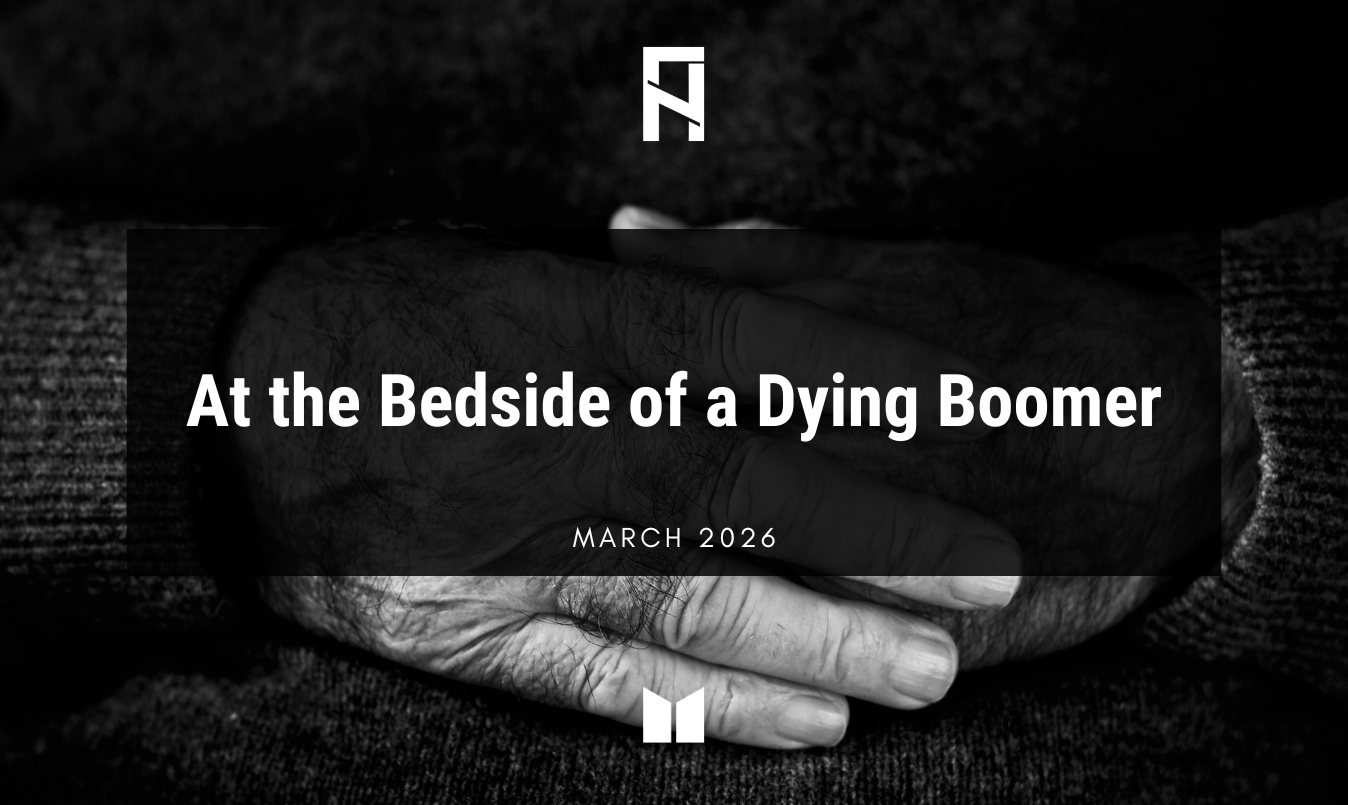
But as I hold his hand—a hand that worked, that held, that remained—I realize he did the one thing that matters in the end: he stood his watch until the sun went down. And in the silence of this room, that is enough. It is more than enough.
Goodnight, Dad. I’ll see you when Morning comes.