**This article was originally published for The Long Middle on Substack**
Guys, we finally did it! We’ve climbed the whole pyramid.
Food, shelter, safety, belonging, esteem. Maslow drew the hierarchy and we spent a century clawing up it, and now a lot of us in America live near the top: all basic needs met, calendars chock-full of busyness, with a constant ache of low grade, gnawing boredom to boot.
As such, we must continue on and go looking for another frontier to conquer. And the last one that still feels dangerous and infinite seems to be sex.
We explore our sexuality more than almost anything else about ourselves now. It’s the center of our Western identity. Heterosexual, homosexual, bisexual, asexual, transsexual, the list keeps going, but I’m not here to litigate the list.
Many lists highlight the variabilities of our differences. I, like Martin Luther King, want to bring us together with a much bigger circle of inclusivity. To do so, let’s consider one orientation nearly all of us actually share.
The self-serving sexual.
SSS, the orientation where the point of sex, underneath whatever else we tell ourselves, is what it does for me. My pleasure. My release. My validation. I’m not here to throw rocks from the outside on this one. I’ll be the first guy to identify as such while everyone else stays closeted.
I mean, it’s easy to see. Look at where the culture actually spends its sexual energy. Every hookup app is a vending machine for the self. Every porn site. Every ad with an American bikini draped body over a truck. The whole architecture points one direction, inward.
The only place I can find sex aimed at someone else is sex that’s for sale. OnlyFans accounts, Magic Mike, the oldest profession. And even that’s a sleight of hand, because serving the client is how you get the client’s money. It’s service in the shape of self-service. We’ve built an entire sexual economy with no real category for giving yourself away, for free, for the good of the other, expecting nothing back.
There’s supposed to be one exception.
Marriage. That whole strange idea of married sex, the thing that’s supposed to set it apart from every transaction, is that it’s selfless service to another person for their sake. You please them. They please you. And the serving itself builds a union that keeps getting deeper.
Might sound like a sermon, but the data says the same thing.
A researcher named Amy Muise has spent years measuring something she calls sexual communal strength. It’s how motivated you are to meet your partner’s sexual needs without keeping score. No tit for tat. And the finding is almost annoyingly on the nose. The people who score high don’t burn out on desire, they sustain it, and their partners end up more satisfied, and so do they. Serving the other turns out to be the thing that keeps the fire lit.
Which runs exactly backwards from how we think sex works.
Because here’s the question everybody’s actually asking, even the ones who’d never say it out loud. Why does sex with one person get boring?
Part of the answer is just chemistry. The brain habituates. New triggers a dopamine spike, familiar doesn’t. Scientists call it the Coolidge effect, and it’s real, it shows up in rats… and in people. Your wife of 12 years does not light up the novelty circuit the way a stranger does. That’s simply a nervous system doing its job, nothing more.
But there’s a second answer, and this one’s a belief problem.
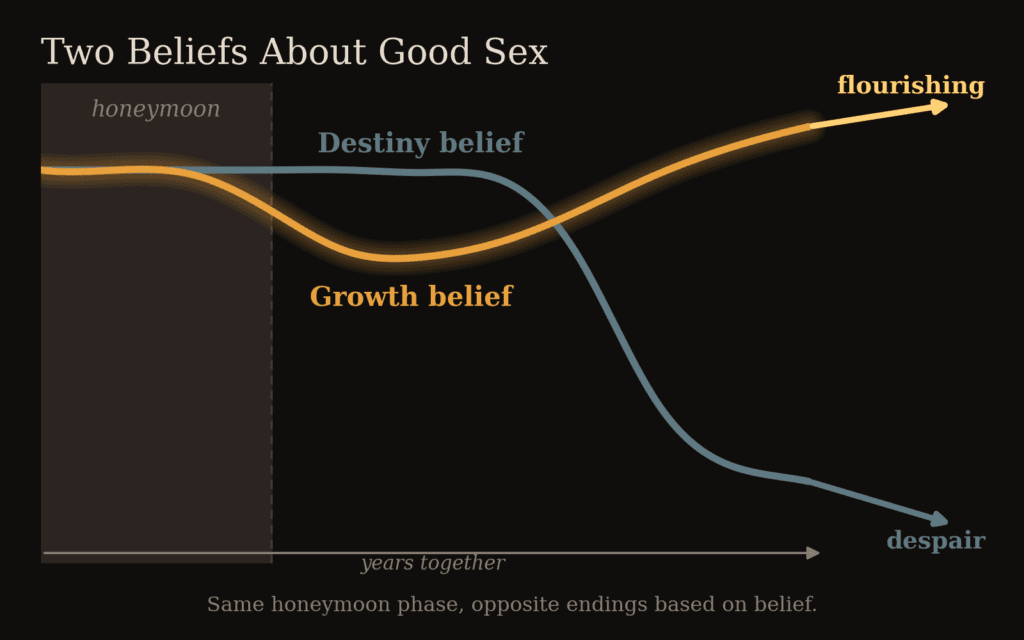
A psychologist named Jessica Maxwell found that people split into two camps. Some believe good sex comes from finding the sexually compatible person, your match, your fit. She calls it a destiny belief. Others believe good sex takes ongoing work, season after season. A growth belief. The catch? For the first 2 or 3 years, both camps are happy. The honeymoon carries everybody. Growth believers naturally dip after the honeymoon phase and start to put in work. Destiny believers hold to the false reality of the honeymoon phase for longer but ultimately crash out at the resignation of realizing that sex has gotten stale. As desire falls off a cliff, the growth believers pull ahead and stay there, them and their partners both.
When sex gets boring, and it will eventually get boring, we ask a very SSS set of questions out of necessity.
Why aren’t they pleasing me the way I want?
Why aren’t they staying curious, finding new pleasure pathways, keeping it interesting for me?
I think mostly we want to be served and end up framing it as having a high “sex drive.”
If both people are self-serving, you get what Keller calls a consumer relationship. Two shoppers, each one checking whether the other is still worth the price, each one half-looking for an upgrade. Desire doesn’t deepen in that kind of arrangement, it eventually evaporates because nobody is actually being given anything.
If one serves and the other only takes, it lasts longer than we’d guess. Muise found a giving partner can buffer a lot of mismatch. But there’s a hard floor, and the same research names it. When serving curdles into self-erasure, into giving with no regard for your own needs at all, it quits helping. The giver ends up depleted and distressed. Service should never be martyrdom. (No one should tell anyone to pour himself out forever into a person who gives nothing back. That was never part of the original deal.)
And then there’s the rare one. Both serving. Each one aimed at the other’s good, and each one able to receive it. A closed feedback loop of giving.
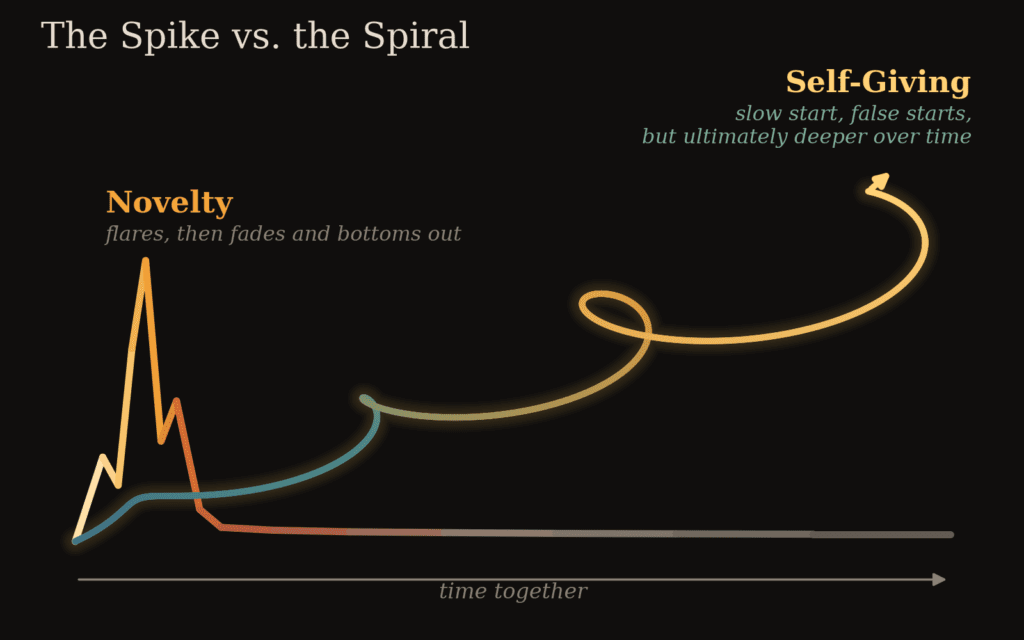
Is that the best sex a person can have? I think it might be. The science won’t use the word “best,” but it keeps saying the thing that sustains desire and satisfaction across decades is mutual responsiveness, two people turned outward. Not the dopamine spike. The spiral.
Now, can there be something better than sex?
From a complete stranger? Probably not. A stranger can only hand you the spike, and the spike is the whole offer. But those spikes offer different problems downstream. It leads you to use people as you grow your spike addiction habit.
But from someone who’s known you for 20 years, who’s watched your body change and your fears shift and your faith wobble and hold fast throughout? Well, I would definitely argue that it is impossible for a one-night stand to reach those heights.
The stranger gives you novelty. The long marriage gives you depth, and depth grows its own novelty if we actually pay attention.
Researchers Rosemary Basson and Emily Nagoski showed that after the first year or so, desire mostly stops being spontaneous and turns responsive. It doesn’t barge in on its own and demand to be fed. It arrives after you’ve built the context, the warmth, the attention, the slow hand. Nagoski’s framing is that desire behaves less like hunger and more like an emotion that needs the right setting before it will show up.
In a long marriage, you don’t wait for desire to hit. You build it. And the only person who can build it with any precision is the one who knows you down to the floorboards.
Ten years in, 20, 40, the bodies change. The hormones thin out. The spontaneous fire that overran the honeymoon phase is simply gone. The self-serving man reads that as the end. The man who’s been paying attention reads it as a bonus room of intimacy, one a stranger could never even find the door to.
We are living in the most sexually unleashed, novelty-soaked stretch of human history. Endless partners a swipe away. Endless porn. No taboo left standing. By the logic of the spike, we should be drowning in great sex.
Yet, here we are having less of it than any generation on record. Weekly sex among American adults fell from about 55% in 1990 to 37% by 2024. Among 18 to 29 year olds, the share who’d had no sex at all in the previous year doubled in a single decade.
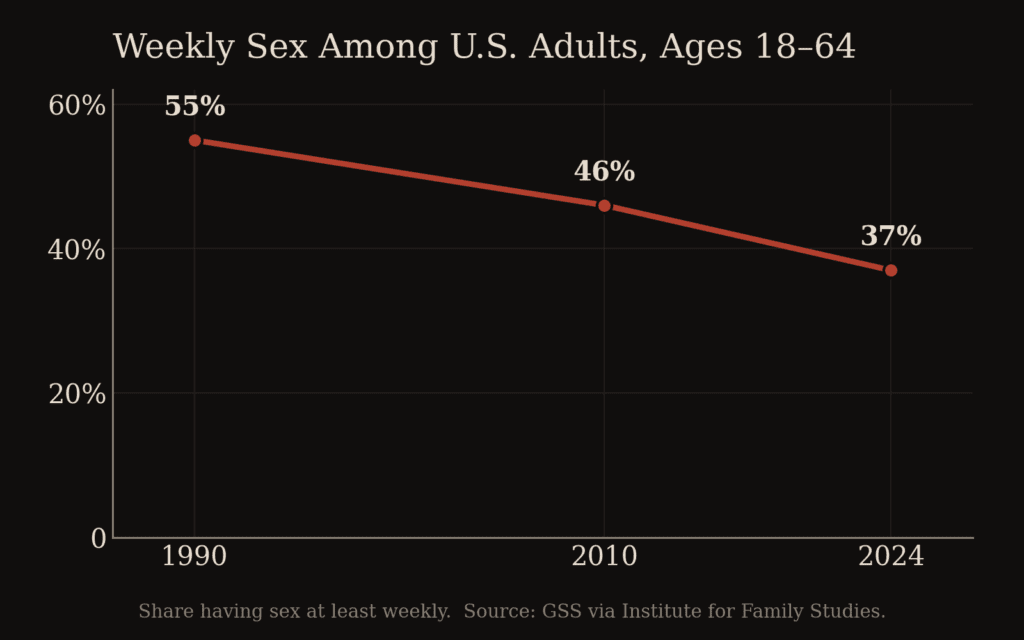
The novelty machine promised a sexual feast but served us a non-freaking famine.
The oldest answer to all of this is also the strangest to me. The Christian tradition has a name for what the body is for. John Paul II called it the nuptial meaning of the body, the body’s built-in power to say, with no words at all, I give myself to you. Sex, in that vision, is a language, and the only true sentence it speaks is self-gift. Lust is using the same grammar to say nothing, chasing the sensation while keeping the self.
Keller said it plainer. Outside of covenant, sex is a consumer good. Inside it, sex is a covenant renewal ceremony, a body saying again what the vows said once. He reads Paul in 1 Corinthians 7 and lauds us to be more interested in giving your spouse pleasure than in getting it.
The aspiration under all of it is a man on a cross saying, “This is my body, given for you.” That’s the sentence married sex is supposed to echo. Given. For you.
Nobody can be Other-Serving Sexual based off of sheer willpower. The self-serving instinct isn’t a habit you can just kick by yourself. The same tradition that hands you the standard admits in the very next breath that you can’t reach it without grace. Which is either the most discouraging line in this whole essay or the only hopeful one, depending on where you’re at today.
Our culture is sitting at the top of the needs pyramid with a full plate, starving. It keeps ordering more novelty and getting hungrier. And the one move that would actually feed it is the one move the whole system has no category for.
Give yourself away. For free. For someone else’s good. Expecting nothing back, except the strange compounding return nobody advertises, because you can’t put it up for sale.
We’re all self-serving sexual while on default mode. The best sex on earth is on the far side of becoming something else, like Someone else.
So what’s the first step off default mode? Stop asking what you’ll get and start asking what you can give, with no scoreboard and no expectation of return. That’s the opposite of a consumer good. It’s a gift. And somebody has to go first.
So, why not you?
And when you get to the point that it feels impossible to do that with your spouse? Well, then you might be ready to surrender to the One that can actually help you get there.